


Upflow → Blog → Financial Relationship Management
Financial Relationship Management Playbook
Alex Louisy
|
July 29, 2026
Generate AI summary


Introduction
For the last twenty years, the way B2B companies managed their customer relationships was transformed by one idea: that every interaction with a customer is data worth capturing, and that data, used well, makes the relationship stronger over time. That idea became the CRM. It changed how sales teams work, how pipeline gets built, and how revenue gets forecasted.
The same transformation has not yet happened in finance. Most finance teams today are running their customer relationships, the ones that sit between invoice and cash, on a combination of spreadsheets, disconnected systems, and manual judgment. The customer that sales spent months closing and CS spends months retaining is treated, the moment an invoice is late, as an accounts receivable problem to be resolved rather than a relationship to be managed.
Financial Relationship Management is the practice of changing that. It is the discipline of treating the invoice-to-cash process not as a back-office function but as a strategic layer of the customer relationship, one that generates signals, requires judgment, and deserves the same intentionality that sales and CS bring to the rest of the account.
Upflow pioneered FRM and remains the only platform built on this principle. This playbook sets out what FRM looks like in practice, the five pillars that underpin it, a maturity audit to locate where your team is now, the tech stack that makes it work, and what three finance teams did when they built it.
Part 1: What Is FRM and Why Now
The phrase Financial Relationship Management captures something that has always been true but rarely been named. Every time a finance team sends an invoice, follows up on an overdue balance, resolves a dispute, or negotiates terms, it is doing relationship work. The only question is whether it is doing that work deliberately.
Most are not. The typical approach to cash collection is reactive by design. An invoice goes out. If it is not paid, a reminder follows. If the reminder does not work, escalation begins. At no point in that sequence does the finance team have a full picture of the account, a view of what sales or CS knows about it, or a sense of whether the late payment is a cash flow problem, a dispute, or a signal that something in the relationship has shifted.
FRM changes the default from reactive to informed. It treats the customer’s payment behavior as a continuous stream of data about the health of the relationship, and it builds the processes and tooling to act on that data before problems reach the ledger.
The reason this matters now is that the financial stakes of getting it wrong have grown. In a SaaS business, revenue is recurring. A customer who pays late this cycle is the same customer you are billing next cycle and the one after. A dispute handled badly sits on an account that is up for renewal in six months. A collections approach that damages the relationship does not just slow the cash, it accelerates the churn. The financial relationship has always mattered. It is just harder to ignore now.
There is a second reason. The tools to do this well have only recently existed. The combination of real-time ERP data, intelligent workflow automation, multi-channel communication, and AI-assisted pattern recognition means that what used to require a large AR team and a great deal of manual judgment can now be built with a lean team and the right system. Upflow built that system, and it is the only one designed from the ground up around FRM as a discipline rather than as a feature.
Part 2: The Five Pillars of FRM
FRM is not a single capability. It is a set of practices that work together, each one building on the last. The five pillars below are not sequential steps. They are permanent components of a functioning FRM approach, the things a team needs to have in place for the financial relationship to be managed well at every point from invoice to cash.
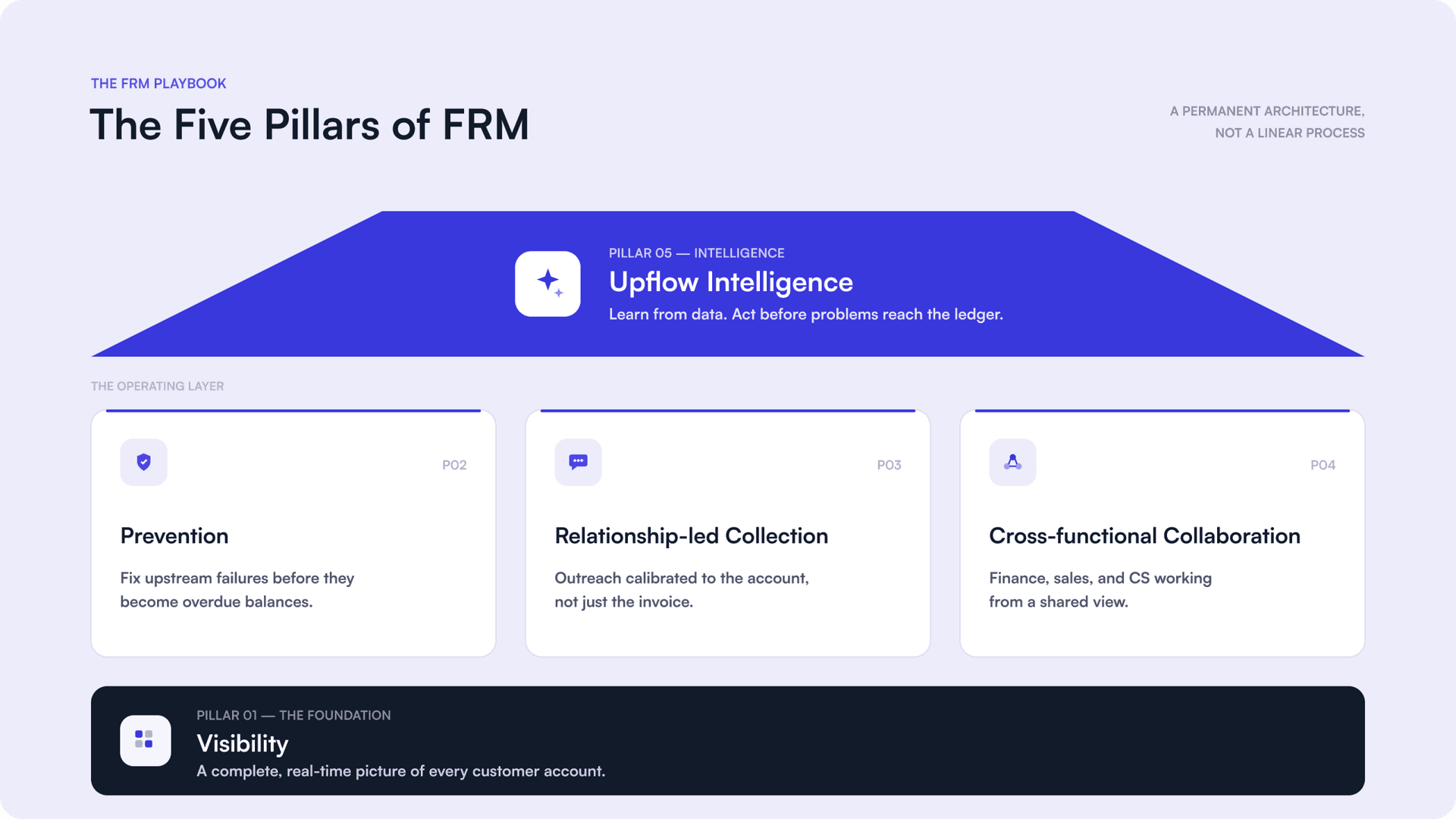
Pillar 1: Visibility
You cannot manage a relationship you cannot see. The first pillar of FRM is having a complete, accurate, real-time picture of your AR across every customer account.
For most finance teams, this is harder than it sounds. Data lives in multiple systems: the billing tool, the ERP, the payment processor, sometimes a CRM. Nobody has made a deliberate decision about which one is authoritative. As a result, the finance team is working from a partial picture, one that updates on a batch schedule, misses payments that have not yet been reconciled, and fails to surface the accounts that are quietly drifting before they become a problem.
Visibility in FRM means solving this. It means a single source of truth for every customer’s outstanding balance, payment history, and collection status, updated in real time and accessible to everyone who needs it. It means knowing not just what is overdue but how each account’s payment behavior is trending: whether a customer who used to pay in thirty days has quietly moved to forty-five, and what that shift might mean.
This is the foundation everything else depends on. A segmentation strategy built on stale data misfires. A collection timeline applied without visibility into what has already been sent produces duplicate chasers and missed escalations. Visibility is where FRM begins, and for many teams it is also where the most immediate gains are.
Pillar 2: Prevention
The second pillar is the one most finance teams do not think of as collection work at all. Most overdue invoices are not the result of customers who will not pay. They are the result of something that went wrong before the invoice existed: a term agreed in the deal that never made it into billing, an invoice that went to a contact who left six months ago, a pricing structure too complex for the customer’s AP team to approve without querying it first.
Prevention in FRM is the practice of identifying and fixing those upstream failure points before they produce overdue balances downstream. It means making sure payment terms agreed in the deal match the invoice that gets generated. It means confirming, during onboarding, that the right person on the customer’s side has received the invoice and knows how to pay it. It means building invoices accurate enough that the customer can approve them without a query.
This is not glamorous work. It sits upstream of the collection function, often in the handoff between sales and finance, and it requires those teams to be more deliberate about what information gets captured and where. But the return is real. Every dispute prevented is a conversation that never needed to happen. Every invoice paid without a chase is an account that experienced the financial relationship at its best.
Pillar 3: Relationship-led Collection
The third pillar is what distinguishes FRM from basic AR automation. Collection in a B2B SaaS company is not primarily a cash recovery exercise. It is an ongoing interaction with a customer who has a commercial relationship with multiple parts of your business, and the way that interaction is handled sends a signal back about what kind of company you are.
Relationship-led collection means treating the collection process as part of the customer experience. It means knowing, before you reach out to an account, what sales is working on with them and what CS has flagged. It means calibrating the tone and frequency of outreach to the account’s value and history, not applying the same reminder sequence to every customer regardless of who they are. It means recognizing that a customer who has paid reliably for two years and then misses a payment probably has a reason, and that a phone call from the right person is a better first move than an automated chase.
It also means knowing when to escalate and how. When a payment has been late long enough that the account needs a senior conversation, that conversation should come from someone who carries weight with the customer: a head of finance, an account executive, or a CS lead who owns the relationship. The job of the collection function is not to run that conversation alone. It is to get the right people into it, with the right context, at the right moment.
Pillar 4: Cross-functional Collaboration
The fourth pillar is what makes the third possible. Collection does not happen in finance alone, and building it as though it does is one of the most common reasons it breaks down. Sales knows things about an account that the payment record does not show. CS knows whether a customer is happy, growing, or quietly considering a move. Leadership needs to see AR health not as a monthly metric but as a live view of what is coming in and what is at risk.
Cross-functional collaboration in FRM means building the connections that let those teams work together on the financial relationship without pulling anyone off their primary job. It means CS and sales can see what is open on an account before they talk to the customer, so they are not caught off guard by a late payment the customer assumed someone would have raised. It means finance can flag to CS when a customer’s payment behavior suggests something has changed, because that signal often precedes a support ticket or a churn risk by weeks.
This does not require new headcount or new processes for every team. It requires one shared view of the financial relationship and a clear understanding of what each team’s role is within it. That clarity is what keeps the cross-functional effort from becoming a committee and allows finance to run collection without constant escalation.
Pillar 5: Intelligence
The fifth pillar is the one still being built at most companies. Intelligence in FRM is the capacity to learn from the data the financial relationship generates and use that learning to make better decisions: automatically where the decision is routine, and with better information where it requires judgment.
At the operational level, this means the collection system knows which accounts to prioritize today without someone having to rank them manually. It means payment patterns across the customer base surface insights that no individual team member could hold, which industries pay fastest, which deal structures produce the most disputes, which customer profiles are most likely to pay on time without a reminder.
At the strategic level, intelligence means the finance team is no longer surprised by what it finds when it looks at the AR. It is already watching the accounts that are starting to drift, already understanding the upstream causes of the disputes that keep appearing. That shift, from reactive to anticipatory, is what the intelligence pillar is for. It is also where Upflow’s AI agents, built on real behavioral data from thousands of collection sequences, do the most distinctive work.
Part 3: Audit Your FRM Maturity
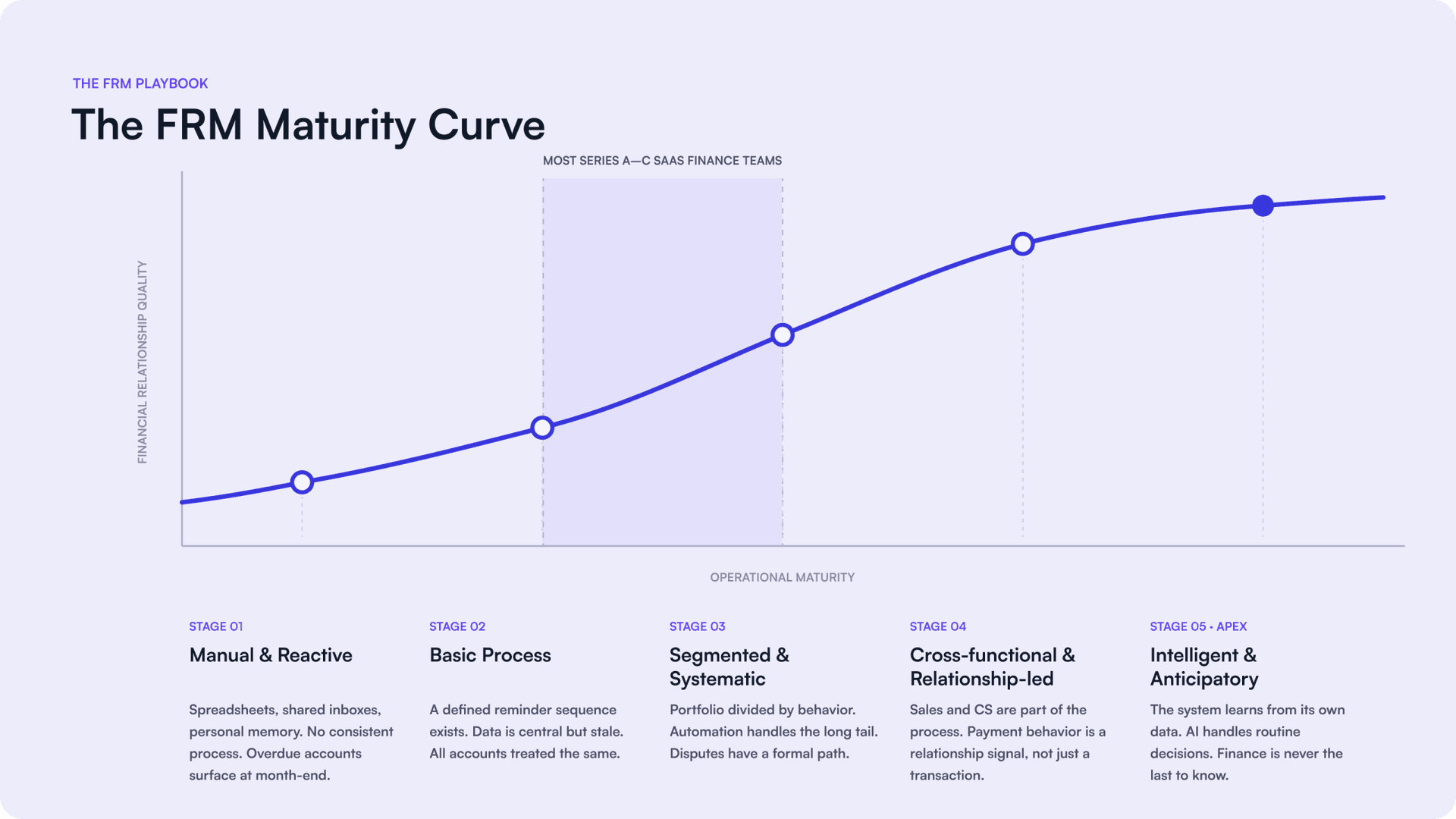
Most finance teams are somewhere on a maturity curve. The five stages below describe that curve from the starting point through to a fully functioning FRM operation. The goal is not to reach stage five on every dimension at once. It is to know where you are, so you can make deliberate decisions about what to build next.
Stage 1: Manual and reactive
Collection runs on spreadsheets, shared inboxes, and personal memory. There is no consistent process. Reminders go out when someone remembers to send them. The finance team has no real-time picture of the AR, and overdue accounts surface through month-end reviews or customer complaints. This is survivable at low invoice volumes. It breaks as the business grows.
Stage 2: Basic process in place
The team has a defined reminder sequence and a central place where AR data lives. Collection is not yet consistent, but there is a recognizable structure. The main gaps are visibility, where data is still not fully real-time or consolidated, and segmentation, where all accounts get treated the same regardless of size or behavior. This is where most early-stage SaaS finance teams operate.
Stage 3: Segmented and systematic
The portfolio is divided into segments, and each segment has a different approach: a different cadence, a different channel mix, and a different escalation path. Automation handles the high-volume, low-touch accounts. Human attention is concentrated on the accounts that warrant it. Disputes have a formal capture and routing process. Prevention work is underway, if not yet complete. The finance team is no longer reactive by default.
Stage 4: Cross-functional and relationship-led
Collection is no longer a finance-only function. Sales and CS are part of the process, with clear roles and a shared view of the financial relationship. The data finance generates flows to the people who need it, and what those teams know about an account flows back to finance. The collection function treats payment behavior as a signal about the relationship, not just a transaction to be resolved.
Stage 5: Intelligent and anticipatory
The system learns from its own data. Pattern recognition surfaces accounts that are drifting before they miss a payment. Upstream causes of disputes and short payments are identified and fixed. The AI layer handles routine decisions autonomously and brings the judgment calls to a human with the full context they need. Leadership has a live view of AR health and uses it to make strategic decisions. Finance is no longer the last team to know when something is going wrong.
Most SaaS finance teams at Series A to Series C sit between stages 2 and 3. They have a process, but it is not yet segmented or relationship-led. The jump from stage 2 to stage 3 produces the most immediate results: faster collection, fewer disputes, less time per invoice. The jump from stage 3 to stage 4 is the one that protects revenue.
Part 4: The FRM Tech Stack
FRM is a practice, not a product. But like any practice at scale, it runs on tools, and the tools you choose determine how much of the practice you can actually execute.
The FRM stack has four layers. Each does a different job. The right stack is the one where these layers talk to each other cleanly, with as few manual steps between them as possible.
Layer 1: The ERP and billing system
This is where the financial record lives. NetSuite, Sage Intacct, QuickBooks, Xero: the ERP holds the invoice, the customer record, and the payment history. The billing tool generates the invoice and handles the billing logic. These are the sources of truth the FRM layer reads from. Their data has to be accurate and synced in real time for anything built on top of them to be trusted.
Layer 2: The FRM platform
This is the layer that connects the ERP data to the collection function. Upflow is the only platform built for this role as a dedicated FRM solution rather than an add-on to something else. It holds the workflow logic, surfaces the account context a collection team needs before reaching out, captures disputes, logs all communication against the customer timeline, and provides the analytics that tell the team what is working. This is the layer most teams are missing when they find collection hard to scale.
Layer 3: The payment layer
Customers pay through a portal. The portal should be branded, clear, and frictionless: showing the customer exactly what they owe, letting them pay by card or bank transfer, giving them the option to set up autopay or direct debit, and letting them download documents, raise a dispute, or set a promise-to-pay date without sending an email. Every step removed between the reminder and the payment is a reminder that does not need to be sent.
Layer 4: The intelligence layer
This is where the data the FRM platform generates gets turned into decisions. AI assistants that surface account risk. Pattern recognition that identifies the upstream causes of disputes. Autonomous agents that handle routine collection sequences without human input. Upflow’s intelligence layer is trained on behavioral data from thousands of real collection sequences, which is what separates pattern recognition built on your industry from pattern recognition built on generic assumptions. For most teams, the starting point is getting layers 1 through 3 working well. The intelligence layer becomes useful once the data underneath it is clean and complete.
Part 5: Three Teams That Built It
Side: from 75% overdue to 25% in eighteen months
When Grégory Labery joined Side as Billing and Recovery Lead, 75% of invoices were overdue and DSO was sitting at twice the target. The problem was not the volume alone. Without any way to segment or prioritize, the only rational response was to focus on the largest balances and let everything below a certain size go. Those smaller invoices were not being ignored out of carelessness. There was just no other choice. Side was writing off close to 5% of revenue every year not because those customers refused to pay, but because nobody had the capacity to ask them.
What changed was segmentation and visibility working together. With a full picture of the portfolio and the ability to run different workflows against different account types, Grégory could reach every invoice, not just the large ones. After eighteen months, 75% of invoices were paid before the due date and write-offs had been eliminated.
WorkMotion: relationship-led collection at scale
Emilie Hart, Finance Operations Team Lead at WorkMotion, had a process before she had a system. Every reminder cycle meant extracting data from the ERP, rebuilding it in Excel, and working through accounts manually, a process that could take a full day just to send a single round of reminders. With 10-day payment terms and a monthly payroll obligation, there was no margin for that kind of delay.
What WorkMotion built was not just faster automation. It was a collection approach that treated customers as individuals rather than line items. Reminders went out at the right moment for each account. The outstanding balance feature let the team send proactive reminders on accounts where something was trending wrong before the due date passed. CS and collections worked from the same place, with notes pinned to the customer timeline so every team member could see what had been said and what was agreed. Invoices more than thirty days overdue fell by 79%.
Malt: keeping up with hyper-growth
Audrey Brunet, Client Operations Team Lead at Malt, was managing a customer base growing faster than any manual process could track. The team knew reminders needed to go out. What they could not see was which accounts were waiting on a follow-up, what had already been sent, or where urgent attention needed to land. The default was bulk reminders to everyone, which produced DSO climbing steadily while the team worked harder.
The shift was visibility first, then segmentation. With a real-time view of every account’s status and a workflow system that directed attention to where it mattered, the team could do more with the same headcount. Over 160 hours were freed up each month. DSO fell 58%. The cases Audrey describes that meant the most were the ones her team caught early: accounts where the data showed something shifting before a payment was missed, because that is where the financial relationship is easiest to protect.
Part 6: Getting Started
FRM is not something you build in a week. But you can start it in one. The sequence below is designed for a finance team that has recognized the gap between how it currently manages the financial relationship and how it wants to. It prioritizes the steps that produce the most immediate change.
Week 1: Get a clear picture of where you are
Run the maturity audit in Part 3. Pull your current DSO, aging balance, and CEI. Identify the three accounts in your portfolio that represent the biggest collection risk right now and ask why each one is there.
Weeks 2 and 3: Consolidate your data
Identify every system that holds data about your invoices, payments, and customers. Find the gaps, where data is not syncing automatically, where someone is reconciling manually. Make a decision about which system is authoritative and start the work of getting everything else to feed into it accurately.
Weeks 3 and 4: Segment your portfolio
Divide your accounts into groups based on value, payment behavior, and strategic weight. Keep it simple to start. Two or three segments is enough. Build a different approach for each one. High-value accounts with declining payment behavior get personal attention and a shorter escalation path. The long tail gets automation. Review the segmentation once a month.
Month 2: Build the cross-functional layer
Sit down with CS and sales. Agree what information finance needs from them and what you will share in return. Set up a shared view that both teams can access without logging into a finance tool. Agree when finance brings them in on an account and what you are asking for when you do.
Ongoing: Measure what matters
Track DSO, CEI, aging balance, and billing cohorts. Run them as a set, not in isolation. Watch for the combinations that tell you something is happening: DSO stable while aging balance is growing, CEI falling while write-offs are flat. When you see a pattern, trace it back to its cause before you respond to the symptom.
The question to hold as you build: at every stage, ask whether what you are building treats the financial relationship as something worth managing, or whether it treats collection as a problem to be processed. That question is what keeps the practice from becoming a machine.

Alex Louisy
Co-founder and CEO of Upflow
Alex is the Co-founder and CEO of Upflow, where he leads the company’s mission to revolutionize how B2B businesses manage their cash flow. Backed by top-tier investors like Hedosophia, YCombinator, Hexa, and Lorimer Ventures, with more than $25m in funding to date, he is a strong advocate for financial transparency and operational excellence, bringing a founder’s perspective to the biggest challenges and opportunities in modern revenue management.
Alex developed Upflow’s widely recognized “5 Maturity Stages of Cash Collection” framework, a model that has helped hundreds of companies build scalable and efficient finance operations. He also co-hosts The Growth-Minded CFO podcast, where he engages with finance and business leaders on innovative approaches to financial leadership. His thought leadership explores the intersection of business strategy, financial discipline, and organizational growth.
As a regular contributor to Upflow’s blog, Alex shares insights on leadership, scaling SaaS businesses, and the future of B2B finance. His writing helps founders, CFOs, and revenue leaders make smarter decisions and build financially resilient companies.

Summary
Shared
Related articles


Financial Relationship Management
ERP vs. CRM: Key Differences and How They Work Together
ERP & CRM systems streamline many areas of business, but what about finance? Learn their differences, benefits, and how Financial Relationship Management (FRM) by Upflow fills the gap

Quentin Gaudinat
March 13, 2025